How Do You Know If Your Digital Marketing Is Actually Working?
Key Performance Indicators (KPIs): How to Measure Digital Marketing Success
Most business owners can tell you exactly what they’re spending on marketing. What they can’t tell you is whether any of it is working. The short answer: if you’re not tracking conversions — actual calls, form fills, and purchases — you don’t know, and impressions won’t tell you. Here’s a practical framework to get clear on what your marketing is actually doing for your business.
The Shift to Performance-Based Digital Marketing
Here’s a scenario that plays out more often than it should. A business owner is doing everything they’ve been told to do — posting on social media, running Google Ads, keeping up with email newsletters, and investing in SEO. They are genuinely trying to build a successful digital marketing campaign, but they lack the visibility to prove it.
Then someone asks how much revenue their Google Ads generated last month.
Crickets.
Not because they’re not paying attention, but because nobody ever set up the systems to track what the marketing is actually doing. So real money goes out every single month, and the results are a mystery.
Here’s the thing: your marketing is probably doing something. It’s probably driving traffic to your website. But traffic alone doesn’t pay your bills. A thousand visitors who don’t call, buy, or fill out a form are worth exactly zero dollars.
The shift you need to make is from tracking activity to tracking outcomes.
The ITC Framework: Measuring Digital Marketing Effectively
Every marketing campaign you run — Google Ads, Meta ads, SEO, email, doesn’t matter — moves through three phases before it puts money in your pocket. At Muletown, we call it the ITC Framework: Impressions, Traffic, Conversions.
Impressions are when someone sees your stuff. Your ad shows up in their feed. Your website appears in a search result. This is awareness, and it’s a necessary first step. It is not, however, a result.
Traffic is when they actually click and land on your website. Now you have their attention.
Conversions are when they do the thing you want them to do. They buy, they call, they fill out the form, they book the appointment. This is the only phase that actually moves your business forward.
The reason this framework matters is diagnostic. If something isn’t working in your marketing, the problem is always breaking down at one of those three stages — and once you identify which one, you know how to fix it.
Low impressions mean a reach problem: not enough people are seeing you. That’s a budget or campaign setup issue. Solid impressions but low traffic mean a messaging problem: people see you but aren’t compelled to click. And good traffic with no conversions? That’s a website or offer problem. People are showing up, they’re just not doing anything when they get there.
ITC gives you a place to start instead of just saying “my marketing isn’t working.”
Key Performance Indicators for Digital Marketing (The KPIs & Metrics That Matter)
To establish true performance-based digital marketing, you have to look past the numbers that just look great on a report. You need to focus on the exact key performance indicators (KPIs) for digital marketing that impact cash flow.
Here’s how it usually goes: a marketing agency sends over the monthly report. Two million impressions. Beautiful graphs. Everyone feels good. Nobody asks about leads.
Two million people saw the ad. Zero leads tracked. That’s not a win. That’s an expensive billboard in the middle of nowhere.
This happens because big numbers feel like progress. Agencies get to keep their contracts. Business owners feel like something is happening. And nobody has to have the uncomfortable conversation about whether the spend is actually converting into revenue.
That conversation is worth having. Pretty dashboards aren’t the same as results. Make sure whoever is managing your marketing can answer the question: “How many leads or sales did this generate?”
If they can’t answer that, you have a tracking problem that needs to be fixed before you spend another dollar.

How to Measure Digital Marketing Performance in Service Businesses
For contractors, law firms, agencies, landscapers, and most other service businesses, a conversion is almost always one of three things: a phone call, a form fill, or a booked appointment. Everything else is just steps on the way to one of those outcomes.
Build your tracking system around those three things. At a minimum, here’s what you need when measuring digital marketing:
Google Analytics tells you who’s coming to your site, where they came from, and what they’re doing once they get there.
Google Search Console shows you whether you’re showing up in search, for what keywords, and how often people are clicking through.
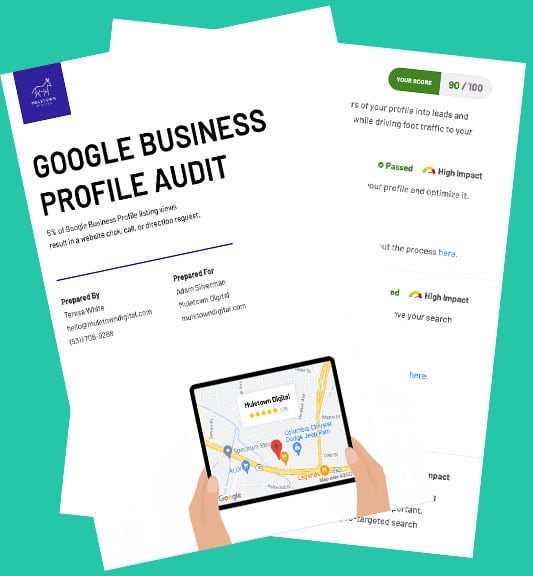
Google Business Profile is non-negotiable for local service businesses. A significant portion of your calls and direction requests come directly from this listing.
Call tracking is the one most businesses skip, and it’s a real gap. If you don’t know which marketing channel is generating phone calls, you’re missing half the picture.
One more thing worth saying about attribution: you’re going to be tempted to track exactly where every lead came from, down to the individual ad and keyword. Let that go. Think about how your customers actually find you. They might have seen a Facebook ad eight weeks ago, talked to a neighbor who mentioned your company, Googled your name a month later, and finally clicked a retargeting ad before calling. Which channel gets credit?
All of them. And none of them individually.
What you can do is look at the whole picture: how much are you spending on marketing total, and are your leads and revenue trending in the right direction together? Macro clarity over micro precision. It’s a more honest way to measure, and it’ll keep you sane.
Creating a Successful Digital Marketing Campaign for E-Commerce
If you sell products online, you actually have it a bit easier because your conversion is obvious: someone bought something. The number is right there.
Your north star metric is ROAS — Return on Ad Spend. For every dollar you put into advertising, how many dollars in revenue do you get back? Spend $100, generate $400 in sales, your ROAS is 4x.
One thing worth understanding here: a very high ROAS isn’t always a good thing. If your ROAS is sky-high, it often means you’ve found a campaign that’s working and you’re being too conservative with your budget. You’re leaving revenue on the table. The goal isn’t the highest possible ROAS. The goal is the right ROAS for your margins — one that keeps you profitable while you scale.
Measuring digital marketing by e-commerce tracking, you need your platform’s native dashboard (Shopify, WooCommerce, BigCommerce), Google Analytics layered on top for traffic source data and funnel drop-off, and your ad platform dashboards for ROAS, cost per click, and conversion rate by campaign.
Above all else, know two numbers: your customer acquisition cost (how much it costs you to land one customer) and your customer lifetime value (how much that customer is worth to you over time). When you know both, you know exactly how hard you can push on paid advertising and still come out ahead.
Frequently Asked Questions
The core KPIs in digital marketing depend on your channels, but for most small businesses they come down to a short list: website conversion rate, cost per lead, cost per acquisition, organic search traffic, and return on ad spend. If you’re running local SEO, add Google Business Profile views, call clicks, and direction requests. The goal is not to track everything. Pick the two or three numbers that have a direct line to revenue and watch those consistently.
A vanity metric is a number that looks impressive but does not connect to revenue or growth. Things like total impressions, follower counts, and raw pageviews fall into this category. A real metric ties back to a business outcome: leads generated, cost per acquisition, conversion rate, or revenue attributed to a specific channel. If you cannot draw a line between the number and money coming into your business, it is probably a vanity metric.
No. For most small and mid-size service businesses, Google Analytics, Google Search Console, Google Business Profile, and a basic call tracking tool give you everything you need to make smart decisions. The tools aren’t the barrier — setting them up correctly and actually looking at the right numbers is where most businesses fall short.
The honest answer is that most leads can’t be attributed to a single channel, because customers interact with your business across multiple touchpoints before they convert. Rather than chasing perfect attribution, focus on the overall picture: total marketing spend versus total leads and revenue. If those numbers are trending together in a healthy direction, you’re on the right track.
A conversion problem with solid traffic usually points to your website or your offer. The page people land on might not be clearly explaining what you do, building enough trust, or making it easy to take the next step. It could also be a mismatch between who your ads are targeting and who actually buys from you. Either way, the fix starts on the website, not in the ad account.
For most small businesses, a monthly review of the core metrics — leads, conversion rate, cost per lead, and revenue by channel — is enough to spot trends and make adjustments. Checking daily creates noise and leads to reactive decisions based on short-term fluctuations. Weekly is reasonable for businesses running active paid campaigns where budget decisions need to be made quickly.

Ready to See What Your Marketing Is Actually Doing?
If any of this hit close to home, you’re not alone. The good news is it’s fixable. At Muletown Digital, we offer a free marketing analysis where we look at what you have set up, identify the gaps, and give you an honest picture of what’s working and what isn’t. No meaningless dashboards, no fluff. Just a real conversation about your numbers.
Are you struggling to generate leads off of your website?
Ready to turn SEO challenges into opportunities? At Muletown Digital, we know that every missed keyword and technical glitch can hold back your growth. Let our expert team help you fine-tune your strategy—from targeted keyword research to flawless site performance and engaging content that converts. Invest in your online future today and contact us to unlock your website’s full potential.
Other Helpful Digital Marketing Insights
© Copyright 2026 Muletown Digital, LLC. All Rights Reserved.